 Agent Auto-Continue
Guide
What to say instead of Continue
Published
Hah, I know, I know. The app’s literally called Auto-Continue, and here I am telling you not to always say Continue.
Hear me out.
Claude Code stopped at its limit halfway through a migration, and you’re about to schedule Continue for 03:00.
For one turn that’s usually fine: if the agent stopped mid-task and the plan’s in the thread, Continue is all it needs.
Over several turns, it thins out.
Then say what done looks like, what to do when blocked, and what to leave you for the morning.
An open Claude Code session can also pick itself up after its limit, no message needed.
One message, every turn
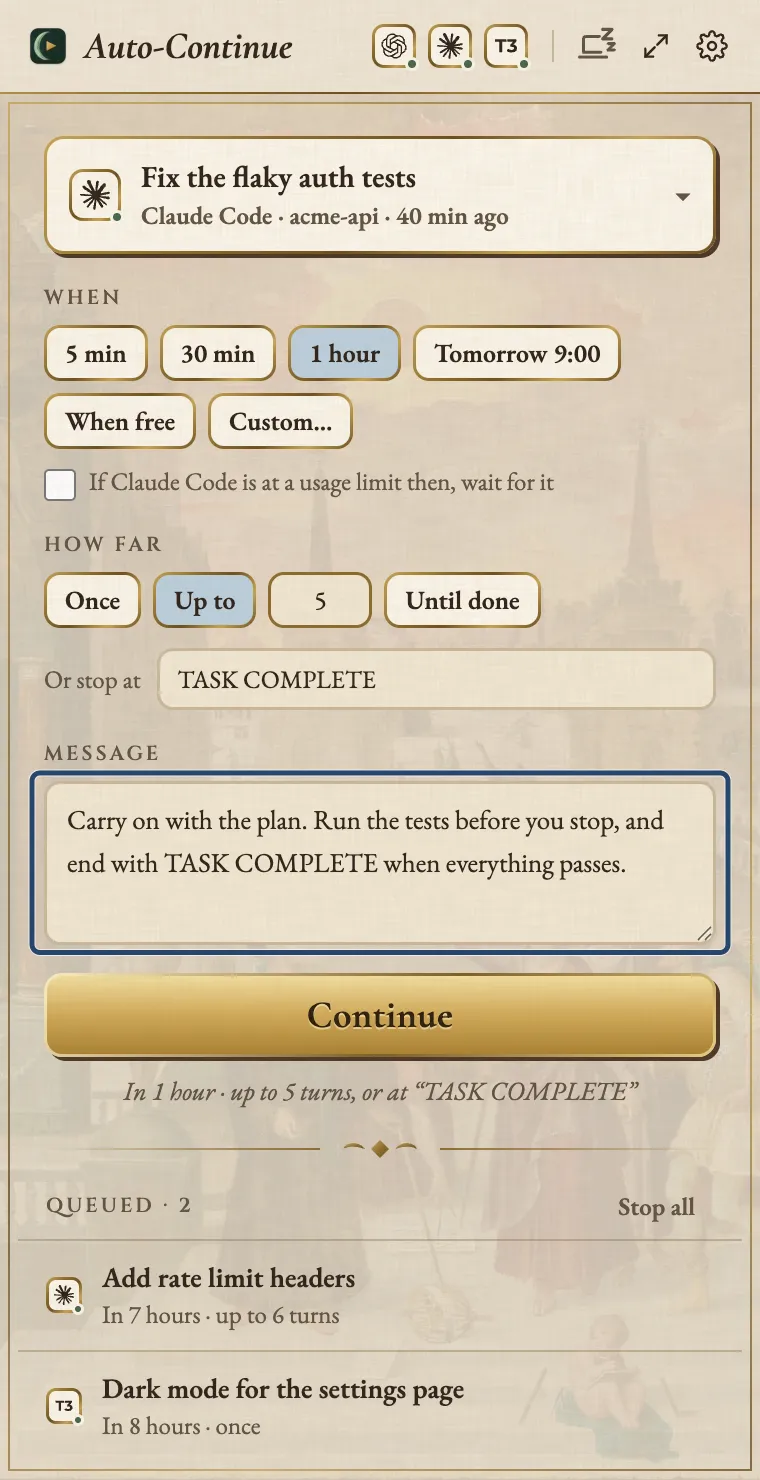
In Agent Auto-Continue, the message is Continue unless you hover the message line and press Edit.
With Up to a number of turns or Until done, every turn sends that same message.
So write a message that still makes sense on turn five. “Now fix the login bug” is fine once, odd the fourth time.
After the first turn the message is locked, so new words mean Stop and schedule again.
Messages worth keeping
| Situation | Send this | Why |
|---|---|---|
| Stopped mid-task at a limit, plan in the thread | Continue | It knows what’s next |
| Several turns, you want it to stop itself | Carry on with the plan. Run the tests before you stop, and end with TASK COMPLETE when everything passes. | Defines “done” in words the app can see |
| You’ll review it in the morning | Carry on. Commit after each step and end with a two-line summary of what changed. | Morning review is a git log, not a scroll |
| Nearly done, might wander | Finish the current task only. Don't start anything new. | Guards the last few turns |
| Likely to hit a permission wall | Carry on. If something's blocked, note it in TODO.md and move to the next step. | One block doesn’t waste the night |
That’s prompting advice, not vendor behaviour, and agents don’t always listen.
Make it end itself
A stop phrase finishes the run when a completed turn’s last message contains it.
- Before you leave, ask the agent to end its final message with
TASK COMPLETEonce the task is done. - In the app, choose Up to or Until done and type the same phrase into Or stop at. A one-turn limit with a phrase is refused.
How it matches:
- Case and spacing don’t matter:
Task complete.matchesTASK COMPLETE. - Whole words only:
Task completeddoesn’t match, andabandoneddoesn’t matchDONE. - 3 to 200 characters.
- Only a completed turn counts; a failed or interrupted one pauses the chain, phrase or not.
- The app never stores the agent’s message, only whether it matched.
The catch: “I’ll write TASK COMPLETE once the tests pass” contains the phrase too. Words can mislead, so the turn limit and Stop stay the real safeguards.
When the app steps in anyway
- Three completed turns in a row that each took under a minute pause the chain (the task may be done).
- Three usage-limited turns in a row pause it too.
- Turns that end at a usage limit don’t count toward the turn limit.
- Type in the conversation and a chain pauses (a one-off is cancelled), so you can always step in.
Permission prompts while you’re asleep
- Claude Code in headless mode denies requests nobody can answer, and the turn carries on without that action. The app reuses the session’s last permission mode, so pick one you’d leave overnight.
- Codex approval requests get the answer that stops the turn, so the chain pauses until you’re back. No wording gets past that; the approval policy decides when Codex asks.
Whether to stay in this thread at all is its own question.
The stop phrase is a convenience. The turn limit is the guard, so when you’re unsure, pick Up to 5 over Until done.
And when Continue really is all it needs, send Continue.
It’s in the name, after all.
Agent Auto-Continue is an independent project. It is not affiliated with, endorsed by, or supported by T3 Tools, Anthropic, OpenAI, or any other agent vendor. Product names are trademarks of their respective owners and are used only to describe compatibility.
Logo moon: Albrecht Altdorfer, The Battle of Alexander at Issus (detail of the crescent), 1529. Alte Pinakothek, Munich, inv. 688. Public domain scan, Google Art Project via Wikimedia Commons.